Murder & Mayhem
After Jesse’s legal battles with money and debt, he moved to Campbell County and probably continued to work as a boatman on the James River. His sisters Betsy and Salley and their families also lived in Lynchburg.
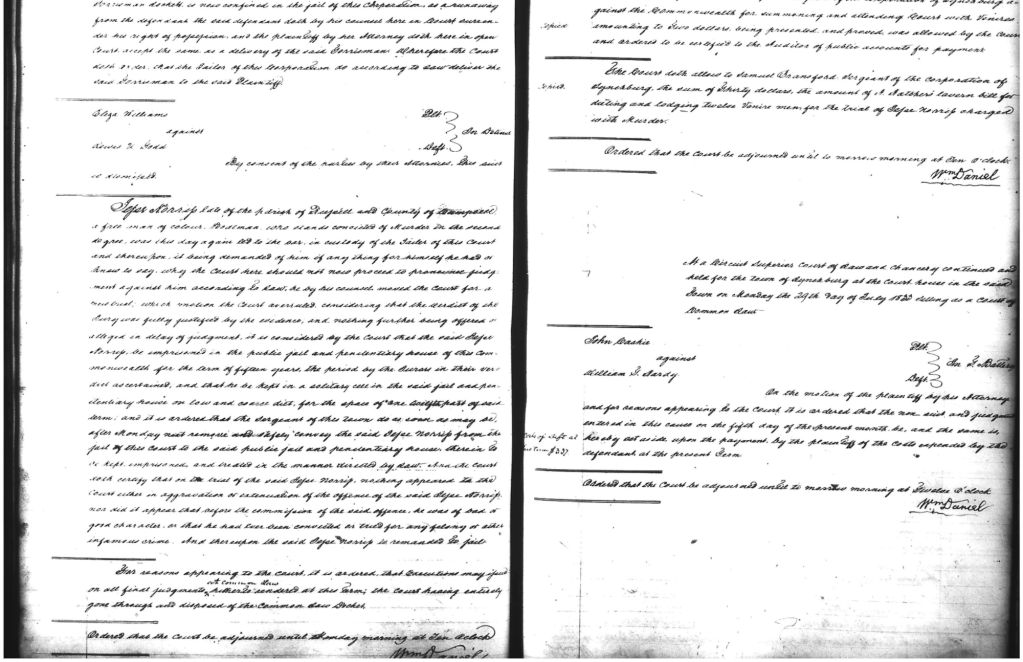
On a Tuesday night, November 6, 1832, Jesse’s life took another dark and twisted turn that he couldn’t this time recover. That night, he and Jackson Hughes (white man) decided to swain knives and together determined 2 out 3 wins. Norris won the first throw; after which Hughes snatched up his stakes and refused to continue to play. Norris and Hughes exchange harsh words at low tones so they weren’t heard. The only words that were overheard by witnesses were of Norris’ abusive epithet that if Hughes advanced a step he would kill him. Hughes advanced a step to temp his fate. Norris promptly stabbed Hughes in the abdomen and once he hit the ground he stomped him as well. Hughes succumbed from infection from the stab wound sixteen days later on November 22, 1832. These actions prompted a murder indictment for Jesse, which he had to hire a team of lawyers (YESS a whole team) defend his freedom as well as save his life.
As Norris vs Commonwealth murder trial began on Tuesday, July 2, 1832, Judge William Daniel of Superior Court in the City Corp of Lynchburg was assigned . The Commonwealth attorney was Christopher Anthony and Norris’ defense team consisted of the following lawyers Cristwell Dahney, June Garland, John Will, and Ferdinand W Risque.
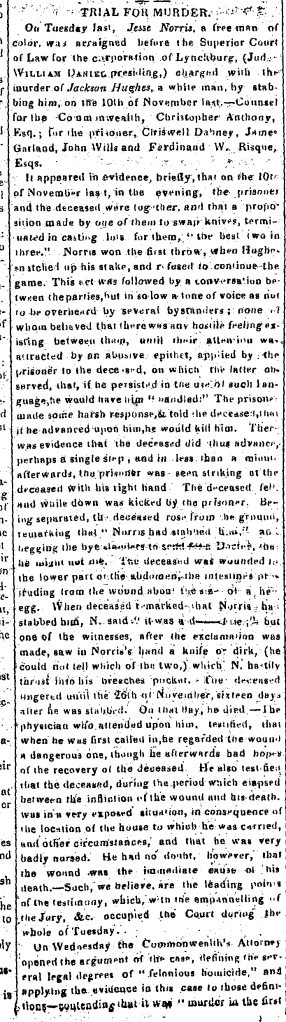
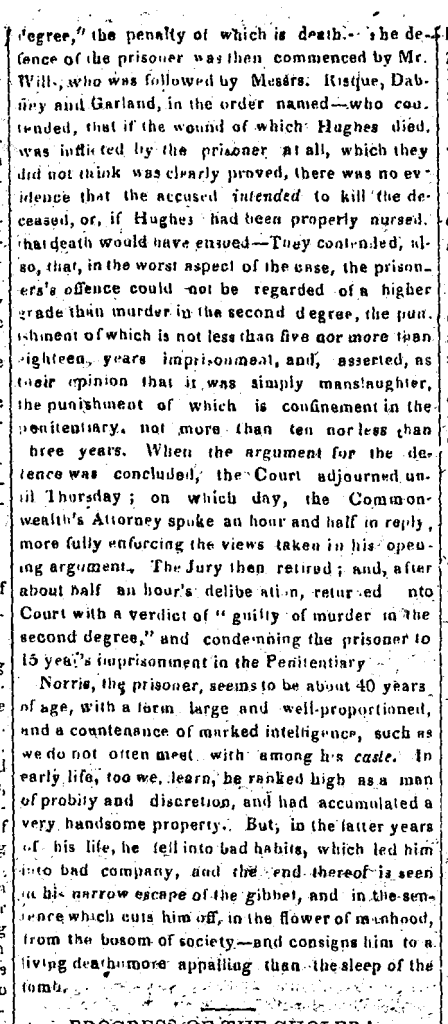
The Commonwealth came out the gates blazing with their opening argument of felonious murder with evidence to prove it and that the offense of murder in first is punishable by death. Norris’ defense’s rebuttal came with ease as Wills from Jesse’s legal team takes the lead. Wills rebutts Norris intent was not to kill and that the death was due to the infection from bad nursing. The doctor testified to how dirty the house was at which Hughes was being cared for after the stabbing. The doctor also corroborated that death was by infection due lack of clean surroundings and the stabbing itself was a survivable offense. Jesse’s legal team argues that with evidence presented the highest charges that can be charge was second degree of murder punishable by 5- 18 years in the pentinetary. The lowest was manslaughter punishable by 3-10 years in the penitentiary. Norris’ team sought the defense of manslaughter. After the both sides presented, the jury was retired and deliberated for approximately 30 minutes. The jury charged Jesse Norris with Second Degree Murder with a sentence of 15 years in the State penitentiary.
A reporter from Lynchburg Virginia also expressed his and the communities’ views of the rise and fall of Jesse Norris as seen in his 1832 society. Here is what they had to say about Jesse.
“Jesse was about 40 years old and termed as large and well proportioned and countenance of marked intelligence not often seen. Early in life, Jesse was as having a high ranking as a man of probity and discretion allowing him to accumulate a very handsome property. In Jesse’s latter years, he fell into bad habits which led him into bad company. This combination caused Jesse to be a flower cut into his manhood from the bosom of society. “
Sources
“Trial For Murder”, Lynchburg Virginian, 04 Jul 1833. Digital images. http://www. genealogybank.com : 2


Leave a Reply